













 On July 24, Vince Tarantini, President and CEO of Carmen Transportation, and his wife, Sonia, Director of Safety and Compliance hosted a frank and wide-ranging roundtable discussion. The meeting was held at the request of Ontario NDP Leader and Official Opposition Leader Marit Stiles, who wanted to hear directly from local business leaders about the challenges they face.
Also at the table were Humber River–Black Creek MPP Tom Rakocevic, Emery Village BIA Executive Director Sandra Farina and BIA Project Manager Al Ruggero. Vince runs a fleet of over 300 trucks. Three-quarters of Carmen’s work is cross-border, making it especially sensitive to tariffs, border policy, and licensing delays.
The meeting fit with a series of recent business roundtables in Emery Village, organized to connect elected officials with local industry leaders. Emery Village is considered the industrial heartland of Canada, home to more than 3,200 businesses and employing over 40,000 workers.
“We move the economy,” Vince said. “If the economy slows, we see it first. If it’s moving up, we see it first.”
One of the biggest concerns around the table was the impact of U.S. tariffs and changing customs practices. Vince described seeing shipments turned away at the border when U.S. customs officers decided Canadian deliveries were taking work from Americans.
“It’s been weaponized,” he said. “You might just get the wrong officer that day. You turn around, reapply online, and re-enter — all because of one interpretation.”
Stiles noted she’s been hearing similar stories across Ontario, from sawmills in Thunder Bay to auto plants in Windsor. “People are reading community newspapers, and they’re paying attention. When these issues come up locally, they matter province-wide.”
The discussion quickly turned to Ontario’s transfer of International Registration Plan (IRP) licensing to ServiceOntario, a move that created months-long delays for trucking companies.
“Licensing is like a production unit in a plant,” Vince said. “If you can’t use that machine today, you shut down production. That’s what happens when trucks can’t be licensed. At some locations, there is only one staff member trained to handle IRP applications. If that person is away, the process grinds to a halt.”
Rakocevic said he raised the issue at Queen’s Park thanks to information provided by Carmen Transportation.
“It used to take three days to a week,” Vince said. “This year, our renewal took over a month. You can’t run a fleet like that.”|
“Driver Inc.,” a growing practice where truck drivers are misclassified as incorporated contractors instead of employees was also a priority. This allows companies to avoid payroll taxes, WSIB premiums, and other obligations — but Vince says it comes at a high cost to the industry and the economy.
“This is a tax avoidance scheme,” he said. “It’s not just an industry problem, it spills into our economy, our homes, and our country.”
While provinces like B.C. and Alberta have stepped up enforcement, Ontario’s response has been slower. The practice also creates ripple effects — from undermining legitimate operators to distorting housing markets when drivers without T4 income use tax credits to qualify for mortgages.
Stiles committed to taking the issue back to her caucus and noted that it had been raised federally as well. “It’s complex,” she said, “but it’s clearly affecting more than just the trucking sector.”
The meeting closed with a discussion about highway safety. Vince argued for 24-hour operation of modern truck inspection stations, which currently run limited hours despite being equipped with advanced sensors and monitoring technology.
“We don’t need more rules — we need more referees,” Vince said. “Inspect us, inspect others, and make sure everyone is safe on the road.”
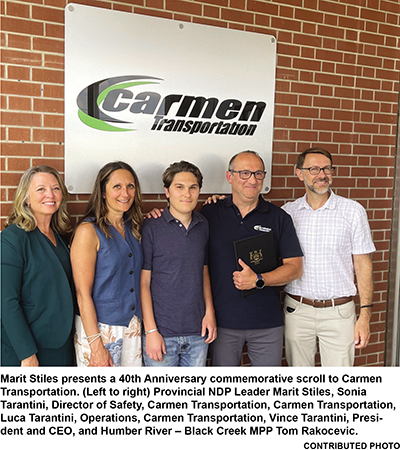
As the roundtable wrapped up, Rakocevic presented Vince with an official scroll marking Carmen Transportation’s 40th anniversary, recognizing its contributions to Ontario’s trucking and logistics sector.
This was more than just a conversation about one company — it was a snapshot of the challenges faced by thousands of businesses in Emery Village and beyond. The Emery Village BIA — alongside elected leaders like Stiles and Rakocevic — will continue to bring these issues to the attention of decision-makers at every level.